Miroslav Koubek Resigns as Czechia Head Coach After FIFA World Cup 2026 Group-Stage Exit
Miroslav Koubek resigns as Czechia head coach after the team's FIFA World Cup 2026 group-stage exit. Here's why the veteran manager stepped down.
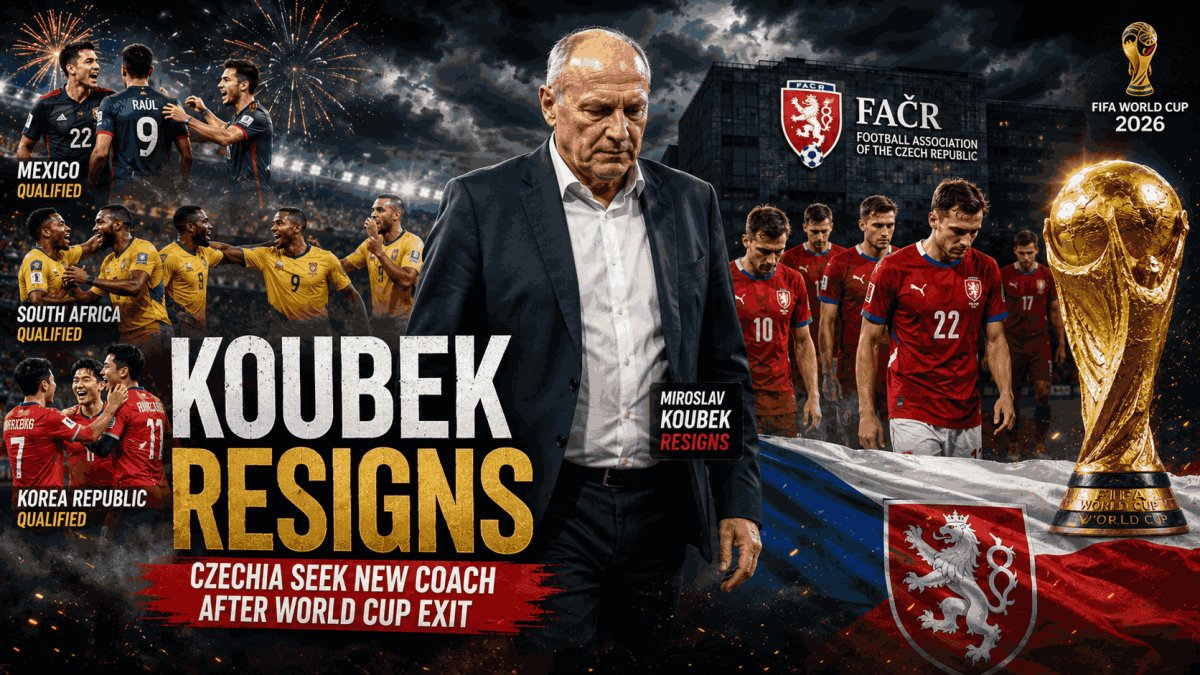
The Czech Republic's FIFA World Cup 2026 campaign has ended with significant changes off the pitch, as veteran head coach Miroslav Koubek has officially stepped down following the team's disappointing group-stage elimination.
The 74-year-old tactician resigned just days after Czechia finished bottom of Group A, bringing a brief yet memorable chapter of his international coaching career to an end.
Koubek's departure comes after Czechia managed just one point from three group-stage matches against Mexico, South Africa, and Korea Republic, failing to secure a place in the knockout rounds of the expanded 48-team FIFA World Cup.
While the tournament itself ended in disappointment, Koubek's contribution to Czech football cannot be judged solely on the team's results in North America. The experienced coach successfully guided Czechia back to the FIFA World Cup after a 20-year absence, achieving a feat many believed would be difficult when he accepted the role earlier this year.
Miroslav Koubek Steps Down Following Honest Discussions
The Football Association of the Czech Republic confirmed Koubek's resignation after a meeting between the coach and association president David Trunda.
According to the federation, Koubek personally offered his resignation after evaluating the team's World Cup campaign.
Trunda accepted the decision following what he described as an open and constructive conversation between both parties.
In an official statement, the Czech FA president said the decision was made after a fair discussion, thanking Koubek for his professionalism and commitment during his short tenure with the national team.
The announcement officially ends Koubek's time in charge less than a year after taking over the position.
Czechia's World Cup Journey Ends in Group A
Returning to football's biggest tournament after two decades, Czechia entered the FIFA World Cup 2026 hoping to make a positive impression.
Instead, Group A proved too challenging. The team finished fourth after collecting only one point from three matches.
Their campaign included difficult fixtures against tournament heavyweights Mexico, an improving South African side, and an organized Korea Republic team.
Unable to convert promising moments into victories, Czechia struggled both offensively and defensively throughout the tournament.
Ultimately, they exited the competition without recording a single win.
For a nation rich in football history, the early elimination was a disappointing conclusion to an otherwise inspiring qualification journey.
A Coach Who Delivered World Cup Qualification
Although his World Cup campaign ended in frustration, Miroslav Koubek deserves significant credit for restoring Czechia to football's grandest stage.
The veteran manager accepted the role shortly before the European nation's crucial World Cup qualification playoffs.
Facing enormous pressure, Koubek successfully guided Czechia through two dramatic knockout encounters.
The team first overcame the Republic of Ireland in a tense penalty shootout before repeating the feat against Denmark, securing qualification for the FIFA World Cup for the first time since 2006.
Those victories ended a 20-year wait for Czech football supporters and re-established the national team among the world's elite nations.
Without Koubek's leadership during the qualification campaign, Czechia may never have reached the finals.
World Cup Campaign Failed to Build Momentum
Despite the excitement surrounding their return to the global stage, Czechia struggled to compete consistently against stronger opposition.
The team's defensive organization came under pressure throughout the group stage, while the attack found it difficult to create clear scoring opportunities.
Mexico dominated Group A with three consecutive victories, while South Africa produced one of the tournament's surprise performances to secure qualification.
Korea Republic also proved more clinical during key moments, leaving Czechia unable to recover after a slow start.
Although several players displayed moments of individual quality, the team lacked the consistency required to progress into the knockout rounds.
Veteran Manager Leaves With Respect
At 74 years old, Miroslav Koubek is one of the most experienced coaches in European football.
His long managerial career has included successful spells in Czech domestic football, where he built a reputation for tactical discipline, calm leadership, and player development.
While international success proved elusive, his willingness to accept responsibility following the World Cup reflects the professionalism that has defined his coaching career.
Rather than waiting for the federation to make a decision, Koubek chose to step aside voluntarily, believing it was the right moment for Czech football to begin a new chapter.
Such decisions are relatively rare in modern football and have earned praise from many supporters and analysts.
Czech Football Faces Important Transition
Attention will now turn toward identifying Koubek's successor. The Football Association of the Czech Republic faces an important decision as it prepares for the upcoming international calendar, including qualification for future UEFA competitions and preparations for the next FIFA World Cup cycle.
The new coach will inherit a squad that blends experienced internationals with promising young players capable of developing into future leaders.
Many observers believe Czech football possesses enough talent to remain competitive in Europe, provided the team receives long-term tactical stability and continued investment in player development.
Lessons from World Cup 2026
Although Czechia's tournament ended earlier than hoped, participation itself represented progress.
The country had spent two decades absent from the world's biggest football event, making qualification a significant achievement in its own right.
Competing against quality opposition such as Mexico, South Africa, and Korea Republic also provided valuable experience for younger members of the squad.
These lessons could prove important as Czechia begins preparing for future international tournaments.
Rather than focusing solely on the disappointment of elimination, the federation is expected to analyze the campaign comprehensively before implementing long-term improvements.
David Trunda Backs a Fresh Start
Football Association president David Trunda has acknowledged the need to move forward while recognizing Koubek's contribution.
His statement reflected appreciation for the coach's efforts in restoring Czechia to the FIFA World Cup after such a lengthy absence.
At the same time, accepting Koubek's resignation signals the federation's intention to begin planning for the future immediately.
Finding the right successor will be one of the association's most significant decisions in the coming months.
Fans Thank Koubek Despite Disappointment
Reaction among Czech supporters has been mixed but largely respectful. While many fans were disappointed with the team's performances during the group stage, there is also widespread recognition that Koubek delivered something Czech football had failed to achieve for two decades—qualification for the FIFA World Cup.
Social media has seen numerous messages thanking the veteran manager for guiding the national team back onto football's biggest stage.
For many supporters, the memories of those dramatic playoff victories over Ireland and Denmark remain among Czech football's greatest recent achievements.
A New Era Begins for Czechia
Miroslav Koubek leaves the Czech national team with a record that reflects both achievement and disappointment.
He restored Czechia's place at the FIFA World Cup after a 20-year absence but was unable to guide the team beyond the group stage. While the World Cup campaign fell short of expectations, his contribution to Czech football will not be forgotten.
The challenge now shifts to the Football Association of the Czech Republic, which must appoint a coach capable of building on the foundation Koubek established. With emerging talent, valuable World Cup experience, and renewed belief among supporters, Czechia has an opportunity to regroup and begin preparing for the next chapter.
As one era comes to an end, another begins—with hopes that the lessons learned from FIFA World Cup 2026 will help shape a stronger future for Czech football.

More Cricket Stories

Suresh Raina Breaks Silence on CSK Batting Coach Role Ahead of IPL 2027

Cricket vibes: IPL 2027 Auction Date, Retention List, India vs Afghanistan 2nd T20I, Abhishek Sharma, Harshit Rana and ICC Rankings

India vs West Indies 4th T20I Today: Yuvraj Singh Joins DC for IPL 2027
ICC ODI Rankings: Virat Kohli Rises to No. 2 After West Indies Masterclass

ICC Men’s Cricket World Cup 2027 Fixtures: India, Australia, Pakistan, England and South Africa Learn Their Road to the Final

England Set to Appoint Eric Simons as Bowling Coach After Ben Stokes’ Praise

Mohammed Siraj Named Hyderabad Captain for Ranji Trophy 2026-27; Full Squad Announced